The Role of Khorgos in Facilitating Trade Cooperation between Kazakhstan and China
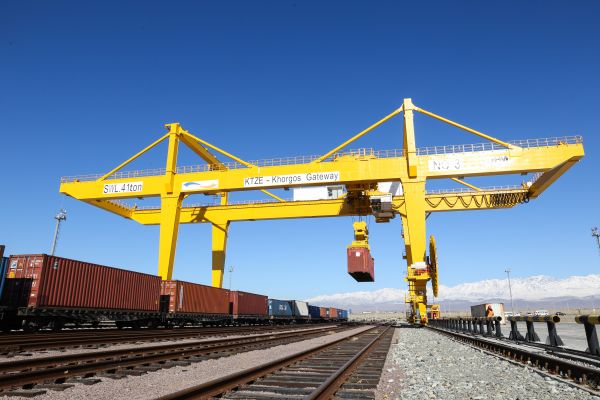
Bordered by geography and bound by shared economic opportunity, Khorgos has evolved into a nexus of trade cooperation between Kazakhstan and China. Originally conceived under Kazakhstan’s Nurly Zhol policy and China’s Belt & Road Initiative (BRI), Khorgos now serves not simply as a transit point but as a testbed for bilateral collaboration in infrastructure, logistics, and regional development. Since its establishment in 2006, the Khorgos International Center for Cross-Border Cooperation (ICBC) has expanded significantly, gaining status as a special economic zone (SEZ) on the Kazakh side in 2017 and developing a dense infrastructure network to enable smoother cross-border flows (Sakenova, 2025).
Trade volumes via Khorgos have grown rapidly, though with varying rates over time. For example, trade throughput reached almost US$10 billion in 2022 (a ~%15 increase over 2021), rose to ~US$12 billion in 2023 (~%20 growth), and then slowed to about US$12.5 billion in 2024 (~%4 growth) (Omirgazy, 2025). Cargo tonnage has also climbed: in the first half of 2025, both import and export volumes via Khorgos passed 22.2 million tons, a %4.3 increase year-on-year, with rail volumes rising ~%22. Such figures underline Khorgos’ growing importance as a trade corridor linking China, Central Asia, and Europe (TheCaspianPost, 2025).
From Kazakhstan’s perspective, Khorgos contributes not just to transit revenue but to regional development. In the Zhetisu Region (south-east Kazakhstan), 78 infrastructure facilities valued at roughly 40.7 billion tenge (~US$77.5 million) have been built, including roads, bridges, utility infrastructure, a passenger terminal, and an automated vehicle inspection complex. Plans for further investment are ambitious: the Khorgos – Eastern Gate SEZ has investment targets of ~522.7 billion tenge (~US$1 billion) by 2030 and ~715.5 billion tenge (~US$1.3 billion) by 2035, intended to strengthen “advanced production, logistics, and cross-border cooperation.” The border checkpoint area is increasingly city-like, with services such as warehouses, malls, hotels, and administrative offices (Sakenova, 2025).
Nevertheless, despite its successes, Khorgos faces multiple issues that complicate its effectiveness in facilitating balanced, sustainable trade cooperation. One major issue is logistical bottlenecks. Rapid growth has strained customs and transport systems. Structural inefficiencies emerge due to differences in regulations between the two countries, mismatched or incompatible information systems, voluminous documentation requirements, and limited automation in some processes. These are partly temporary growing pains, but unless addressed, they risk undermining further growth (Cui and Koshkina, 2025).
Another issue is the trade imbalance and dependency. While trade volumes are rising, the composition still heavily favors Kazakhstan exporting raw materials and importing high-value manufactured goods from China. This imbalance limits value capture for Kazakhstan and leaves it vulnerable to external shocks—whether from demand fluctuations, price volatility in commodities, or geopolitical risk. Experts have pointed out that rising dependence on China for imports may create resilience risks, particularly if China’s economic cycle slows or if external demand weakens (Sakenova, 2025).
A third issue is data discrepancies and transparency, especially related to trade statistics. The Prime Minister of Kazakhstan has noted that in 2024, there was an $18.3 billion discrepancy in import data reported by China versus by Kazakhstan. Differences in methodology, transit counting, under- or over-valuation of goods, and smuggling are cited as causes. These discrepancies complicate policy planning, revenue estimation, and trust between partners (Orda, 2025).
Environmental and social issues also loom. The border region sees increasing infrastructure build-out, which places pressure on land, energy, water, and local infrastructure capacity. Water management, for example, is an issue in the Khorgos region: Kazakhstan has raised concerns about excessive water diversion in shared rivers with China, especially in the Ili basin, which has downstream effects on ecosystems and communities (Eurasianet, 2024; Jumaboyev and Mansurova, 2025). There is also concern that growth may not always benefit local communities: the number of permanent jobs at Khorgos is still relatively modest (~1,135) though expected to double by the end-2026, but regional inequalities, local environmental externalities, and regulatory oversight are ongoing issues (Sakenova, 2025).
In terms of impact assessment, Khorgos has already had positive effects: improved connectivity, reduced transit times, rising trade volumes, foreign direct investment in infrastructure, and local economic development in Zhetisu and adjacent border areas. It has contributed significantly to reinforcing Kazakhstan’s strategic role in Eurasian trade networks and increased China’s overland access to markets in Central Asia and Europe. The creation of SEZs, industrial parks, and logistics hubs has begun to build capacity beyond mere transit. In agriculture, for instance, fresh produce exports from China through Khorgos have increased dramatically (~46.2% year-on-year in early 2025 in some reports) facilitated by “green corridors” for perishables (FreshPlaza, 2025).
However, some of the impacts are mixed. Because much of the value chain remains external to Kazakhstan, benefits in terms of technology transfer, industrial diversification, and higher value-added production are still limited. The trade imbalance means that the risk of adverse shifts in Chinese demand or policy could disproportionately affect Kazakhstan. Bottlenecks in logistics and regulatory mismatches hinder reliability, increasing cost and reducing competitiveness. Discrepancies in trade data affect revenue forecasting and policy trust. Environmental pressures could impose costs (e.g. in water scarcity, land degradation) that may offset some economic gains, especially for local communities (Pannier, 2025).
While the challenges are considerable, they also open up a set of opportunities for future development that could make Khorgos more than a transit corridor. One important direction is the potential to embed value-added activities into the logistics ecosystem. At present, Kazakhstan mainly uses Khorgos for the movement of bulk commodities and raw agricultural products, yet the presence of special economic zones, industrial parks, and incentives around the border hub create space for localized manufacturing, packaging, and processing. If these activities take root, Khorgos could transform from a gateway into a platform where Kazakh producers capture more value before goods even leave the country, thereby contributing to economic diversification and balancing the asymmetry of bilateral trade (Madiyarova and Wong, 2023).
Another opportunity lies in regulatory and digital modernization. The very bottlenecks that now hinder growth—complex customs paperwork, mismatched information systems, and the persistence of manual inspections—are the same areas where innovation could yield rapid gains. Kazakhstan and China have already begun experimenting with “green corridors” for perishable goods and with digitalized cargo monitoring, but the scope for expanding these initiatives is considerable. Harmonized standards, joint customs posts, and shared databases would not only cut costs but also raise trust in reported statistics, a persistent issue given the discrepancies between Kazakh and Chinese trade data (Jumaboyev and Mansurova, 2025). Such reforms would position Khorgos as a model of efficient border governance in Central Asia.
Transparency in reporting also holds developmental promise. The striking difference of $18.3 billion between Chinese and Kazakh import figures for 2024 is not only a problem but also an incentive to build stronger institutional cooperation in data management (Orda, 2025). Joint statistical commissions, cross-checks, and advanced tracking technologies could improve accuracy, reduce opportunities for smuggling, and reassure both governments and investors that Khorgos operates under predictable and credible conditions.
Beyond technical improvements, Khorgos represents an opportunity to re-anchor Kazakhstan’s multi-vector foreign policy in a rapidly shifting geopolitical environment. While it is clear that China is the dominant partner in the project, the openness of the Khorgos hub to external investors creates possibilities for engaging actors from Europe, the Gulf, and other parts of Asia. Diversifying the investor base would not only reduce dependency but also enhance resilience by embedding Khorgos within wider Eurasian networks, thus reinforcing Kazakhstan’s agency in shaping its own connectivity agenda (Pannier, 2025).
Environmental and social issues, though often framed as risks, can equally be viewed as areas of constructive development. Concerns over water scarcity in the Khorgos River basin (Eurasianet, 2025) underscore the urgency of joint resource management, but they also present an opportunity for Kazakhstan and China to pioneer transboundary sustainability practices in Central Asia. Likewise, the pressure on local infrastructure and uneven distribution of benefits could catalyze policies that tie cross-border trade more closely to community development: investing in renewable energy for logistics facilities, expanding housing and public services for workers, and linking SEZ projects to local small and medium enterprises. Such measures would make Khorgos not only a site of international exchange but also a driver of inclusive regional growth (Jumaboyev and Mansurova, 2025).
In a broader perspective, Khorgos is still a relatively young experiment, and the slowdown in trade growth between 2023 and 2024 (Sakenova, 2025) illustrates the volatility of global demand and the competitiveness of alternative corridors. Yet this volatility should not be seen purely as a threat. It also highlights the potential for Khorgos to adapt and reposition itself within changing global supply chains. By building specialized niches—whether in agro-logistics, perishable goods, or high-value intermediate products—Khorgos could move from being one option among many to becoming indispensable for specific types of trade (Pannier, 2025).
In this light, the future of Khorgos will depend on whether Kazakhstan and China can seize these opportunities. The infrastructure itself is already impressive: rail throughput exceeded 22 million tons in the first half of 2025, and planned investments of over a billion dollars by 2030 signal strong state commitment. The next stage is less about building new physical facilities and more about embedding innovation, transparency, inclusivity, and sustainability into existing structures. If this transition succeeds, Khorgos could stand as a model of how borderlands can be transformed from peripheries into dynamic centers of cooperation (Kazinform, 2025).
Ultimately, Khorgos encapsulates the contradictions of Eurasian integration: rapid growth tempered by bottlenecks, opportunities shadowed by imbalances, and local concerns intertwined with global ambitions. Yet it also demonstrates that borders need not be barriers. With deliberate policies and adaptive strategies, Khorgos has the potential to evolve into a cornerstone of Kazakhstan–China cooperation, contributing not only to bilateral trade but to the stability, prosperity, and resilience of the wider region.
References
Cui, Liu, and Koshkina, Olga (2025). Regulatory and Institutional Barriers to Logistics Cooperation Between China and Kazakhstan. BBC: 29.
Eurasianet (2024). Kazakhstan strives to strike water-management deal with China. Retrieved from https://eurasianet.org/kazakhstan-strives-to-strike-water-management-deal-with-china. Accessed on 13.09.2025.
FreshPlaza (2025). China increases fresh produce exports through Khorgos border. Retrieved from https://www.freshplaza.com/asia/article/9717975/china-increases-fresh-produce-exports-through-khorgos-border/. Accessed on 12. 09.2025.
Jumaboev, Behzod, and Mansurova, Makhina (2025). An Overview of Transport Logistics in Kazakhstan: Focus on the Case of Astana. Journal of Multidisciplinary Sciences and Innovations, 1 (3): 1129-1132.
Kazinform (2025). Kazakhstan establishes a new special economic zone Khorgos-Eastern Gate. Retrieved from https://qazinform.com/news/kazakhstan-establishes-new-special-economic-zone-khorgos-eastern-gate-892ed7. Accessed on 13.09.2025.
Madiyarova, Diana, and Yong, Wang (2025). Prospects of the Khorgos Free Economic Zone. Sustainable Development Risks and Risk Management: A Systemic View from the Positions of Economics and Law. Cham: Springer International Publishing: 291-296.
Omirgazy, Dana (2025). Kazakhstan Creates Khorgos – Eastern Gate New Special Economic Zone. Retrieved from https://astanatimes.com/2025/07/kazakhstan-creates-khorgos-eastern-gate-new-special-economic-zone/. Accessed on 14.09.2025.
Orda.kz (2025). Prime Minister Comments on Trade Data Discrepancies Between Kazakhstan and China. Retrieved from https://en.orda.kz/prime-minister-comments-on-trade-data-discrepancies-between-kazakhstan-and-china-7363/. Accessed on 11.09.2025.
Pannier, Bruce (2025). Debt and Development: The Next Chapter of Chinese Investments in Central Asia. Retrieved from https://www.fpri.org/article/2025/08/debt-and-development-the-next-chapter-of-chinese-investments-in-central-asia/. Accessed on 12.09.2025.
Sakenova, Saniya (2025). Khorgos Expands with Trade and Investment, but Bottlenecks Persist. Retrieved from https://astanatimes.com/2025/08/khorgos-expands-with-trade-and-investment-but-bottlenecks-persist/. Accessed on 11.09.2025.
TheCaspianPost (2025). Khorgos Port Trade Hits New Heights, Fueling Kazakhstan-China Connectivity. Retrieved from https://caspianpost.com/kazakhstan/khorgos-port-trade-hits-new-heights-fueling-kazakhstan-china-connectivity. Accessed on 14.09.2025.
Note: The views expressed in this blog are the author’s own and do not necessarily reflect the Institute’s editorial policy.